
Why Incorrect Grab Bar Height and Placement Can Increase Fall Risk
Most people assume that any grab bar, placed anywhere in the bathroom, improves safety. The reality is more nuanced — and more important. Incorrect grab bar height and placement can increase fall risk by misdirecting the user's center of gravity, reducing grip strength at the moment of maximum load, and creating a false sense of security in a position that doesn't match how the person actually moves.
Grab bar height and placement is not guesswork. It's a precise assessment based on the user's height, mobility, dominant hand, and the specific movements they perform in each area of the bathroom. Getting it wrong doesn't just reduce effectiveness — it can actively make the bathroom more dangerous. Our home safety assessments are designed to get this right the first time.
40%Grip strength lost when bar is too high
80%Of senior falls occur in the bathroom
33–36″ADA-required height range for most grab bars
250 lbs Minimum ADA load capacity required
Why Incorrect Grab Bar Height and Placement Can Increase Fall Risk

A grab bar works by giving the user a stable, correctly positioned anchor point that aligns with their natural movement. When the bar is in the wrong position, the user reaches for it — and the angle, direction, or force required to use it works against their balance instead of supporting it.
Critical fact: A grab bar mounted just 4–6 inches too high forces the user to raise their arm above a natural grip angle. At that elevated position, biomechanical studies show grip strength drops by up to 40% — meaning the bar provides less than half the support the user expects at the exact moment of maximum need.
The Most Common Grab Bar Height and Placement Mistakes

Bar Mounted Too High — Forces an Overhead Reach
When a grab bar is installed too high, the user must raise their arm to grip it. This upward angle reduces forearm leverage, weakens grip strength by up to 40%, and shifts the user's center of gravity backward — away from the support they need. During a fall or slip, this is the worst possible position for a grip.
Bar Mounted Too Low — Forces a Dangerous Forward Lean
A grab bar placed too low requires the user to bend forward or downward to reach it, pitching their weight in the direction of the fall rather than against it. This is especially dangerous near toilets and bathtub entries where the user is already transitioning between sitting and standing.
Wrong Orientation for the Movement
Grab bar orientation must match the intended movement. A horizontal bar provides lateral balance while walking or standing. A vertical bar supports sit-to-stand transitions. An angled bar assists bathtub entry and exit. Installing a horizontal bar where a vertical one is needed — or vice versa — provides support in the wrong direction and can redirect force into a fall rather than prevent one.
Bar Placed on the Wrong Side of the Body
Dominant hand and mobility asymmetry matter significantly in grab bar placement. A person with weakness or limited range of motion on one side needs the bar positioned to their stronger side. A bar on the wrong side forces the user to twist or reach across their body — disrupting balance at a critical moment.
Bar Too Far From the Transition Point
Grab bars are most critical at transition points— the moments of stepping in or out of a shower, rising from a toilet, or stepping over a bathtub edge. A bar placed even 12 inches away from where the user naturally reaches during these transitions offers no support when it is needed most.
Single Bar Where Multiple Are Needed
Many bathrooms are fitted with one grab bar when the user's mobility requires two or more — one for entry, one for stability during use, and one to support exit. A single bar creates a gap in the support sequence where the user is unsupported and at risk. Comprehensive grab bar placement accounts for the full movement sequence, not just one moment of it.
Correct Grab Bar Orientation: Matching Bar to Movement

↔Horizontal
Lateral support for balance while standing, walking, or maintaining position during bathing. Best on shower back walls and beside toilets.
↕Vertical
Supports push-up and pull-down movements for sit-to-stand transitions. Best at toilet side and shower entry where the user changes elevation.
↗Angled (45°)
Supports the diagonal body movement of stepping over a bathtub edge. Best at bathtub entry where horizontal and vertical support are both needed.
Every bathroom and every person is different.
Our certified installers conduct a full home safety assessment before recommending height, placement, and orientation — ensuring every bar is in the right position for the right person.
ADA-Compliant Grab Bar Height Guide by Location

Correct grab bar height varies by location and user — professional assessment ensures ADA-compliant positioning every time.
Location | Recommended Height | Orientation | Purpose |
Toilet — side wall | 33″ – 36″ from floor | Horizontal | Lateral support during sit-to-stand |
Toilet — rear wall | 33″ – 36″ from floor | Horizontal | Back support while seated |
Shower — back wall | 33″ – 36″ from floor | Horizontal | Balance during bathing |
Shower — entry | 38″ – 44″ from floor | Vertical | Support stepping in and out |
Bathtub — entry | 33″ – 38″ from floor | Angled (45°) | Support stepping over tub edge |
Bathtub — back wall | 33″ – 36″ from floor | Horizontal | Balance while seated in tub |
Bathtub — side wall | 9″ above tub rim | Horizontal | Support during entry/exit |
Hallway / entryway | 34″ – 38″ from floor | Horizontal | Walking balance and stability |
Important: These ADA ranges are starting points — not one-size-fits-all specifications. A person who is 5'0" has very different optimal grab bar height than someone who is 6'2". A professional assessment accounts for the user's actual height and reach to fine-tune placement within these ranges.
How Incorrect Placement Affects Different Users
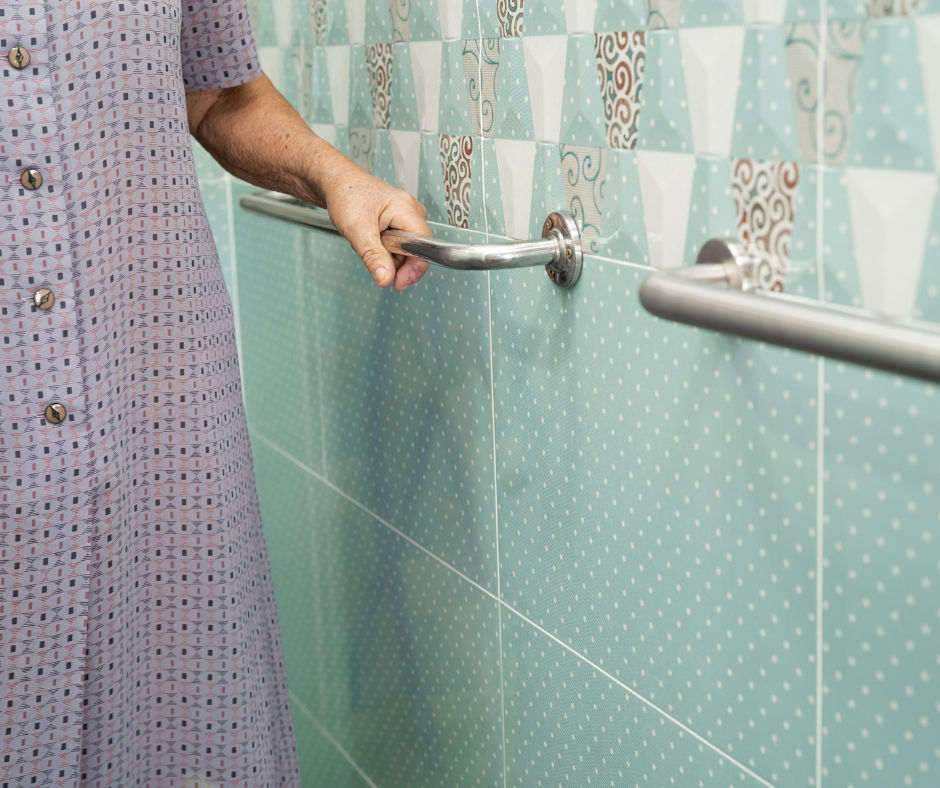
The impact of incorrect grab bar height is not uniform — it compounds based on the user's existing limitations:
Seniors with reduced grip strength — a bar even slightly too high dramatically reduces their already-limited grip capacity, offering almost no support under load
Post-surgery patients — recovering from hip or knee surgery, they rely on precisely positioned bars to avoid putting weight on the healing side; a misplaced bar forces incorrect weight distribution
Individuals with one-sided weakness — a bar on the wrong side forces awkward cross-body reaching that destabilizes rather than steadies
Shorter or taller users — standard "average" placements can be meaningfully wrong for anyone outside the median height range
Users with limited shoulder range of motion — a bar placed even inches above their comfortable reach becomes unusable during a critical moment
Signs Your Existing Grab Bar May Be in the Wrong Position

You have to reach up or bend down to grip the bar — it should be reachable with a natural arm position
The bar feels awkward to hold during normal use — discomfort during regular use signals wrong height or orientation
You instinctively reach for a different surface (towel rack, wall, sink edge) before you reach for the grab bar
The bar is on your non-dominant or weaker side — this is a common installation oversight with significant safety implications
The bar is several feet away from where you step in or out of the shower or bathtub
You feel less stable using it than you do without it — a bar in the wrong orientation can actively disrupt your balance
The standard to aim for: A correctly placed grab bar should feel effortless to reach, natural to grip, and should give you immediate confidence the moment you touch it. If it doesn't — it's in the wrong position.
What a Professional Home Safety Assessment Covers
At Grab Bar Los Angeles, every installation begins with a professional home safety assessment — not a tape measure and a guess. Our certified installers evaluate:
User height and reach — to fine-tune bar height within ADA ranges to the specific person
Dominant hand and any mobility asymmetry — to ensure bars are on the correct side for each user
Specific movements performed in each area — sit-to-stand, stepping over, lateral balance, shower entry — each requires different positioning
Full movement sequence through the bathroom — identifying every transition point where a bar is needed, not just the most obvious one
Bathroom layout and wall type — to confirm the optimal position is also structurally achievable
Bar type and orientation recommendation — horizontal, vertical, angled, or fold-down based on the specific use case
The result is a grab bar installation that works for the specific person in the specific space — not a generic placement that meets the minimum standard and nothing more. View all our services on our services page or learn about our home modification options.
Where We Serve Across Los Angeles
Our certified installers provide professional grab bar installation and home safety assessments across Los Angeles County and surrounding areas — most jobs completed same day.
Arcadia
Pasadena
Glendale
Burbank
Alhambra
San MarinoLa
Cañada
Glendora
Baldwin
ParkLa Verne
Long BeachSanta
MonicaLos Angeles
All of LA County
Frequently Asked Questions: Grab Bar Height and Placement
Why does incorrect grab bar height increase fall risk?▾
A grab bar mounted too high forces the user to reach upward at an angle that reduces grip strength by up to 40% at the moment of maximum load. A bar too low forces a dangerous forward lean. Either scenario misdirects the user's center of gravity at the exact moment they need support — increasing rather than decreasing fall risk.
What is the correct height for a grab bar in a bathroom?▾
Does grab bar orientation matter for safety?▾
Where should grab bars be placed in a shower?▾
Can a grab bar in the wrong location make falls more likely?▾
How does a professional assess the correct grab bar placement for a specific person?▾
Get the Height and Placement Right — the First Time
Our certified installers conduct a full home safety assessment before any bar is mounted. Every installation is positioned for the specific person, backed by a lifetime labor warranty. Serving all of Los Angeles County — most jobs done same day.


Comments